Free Crochet Patterns: Four Full Patterns, No Email Wall
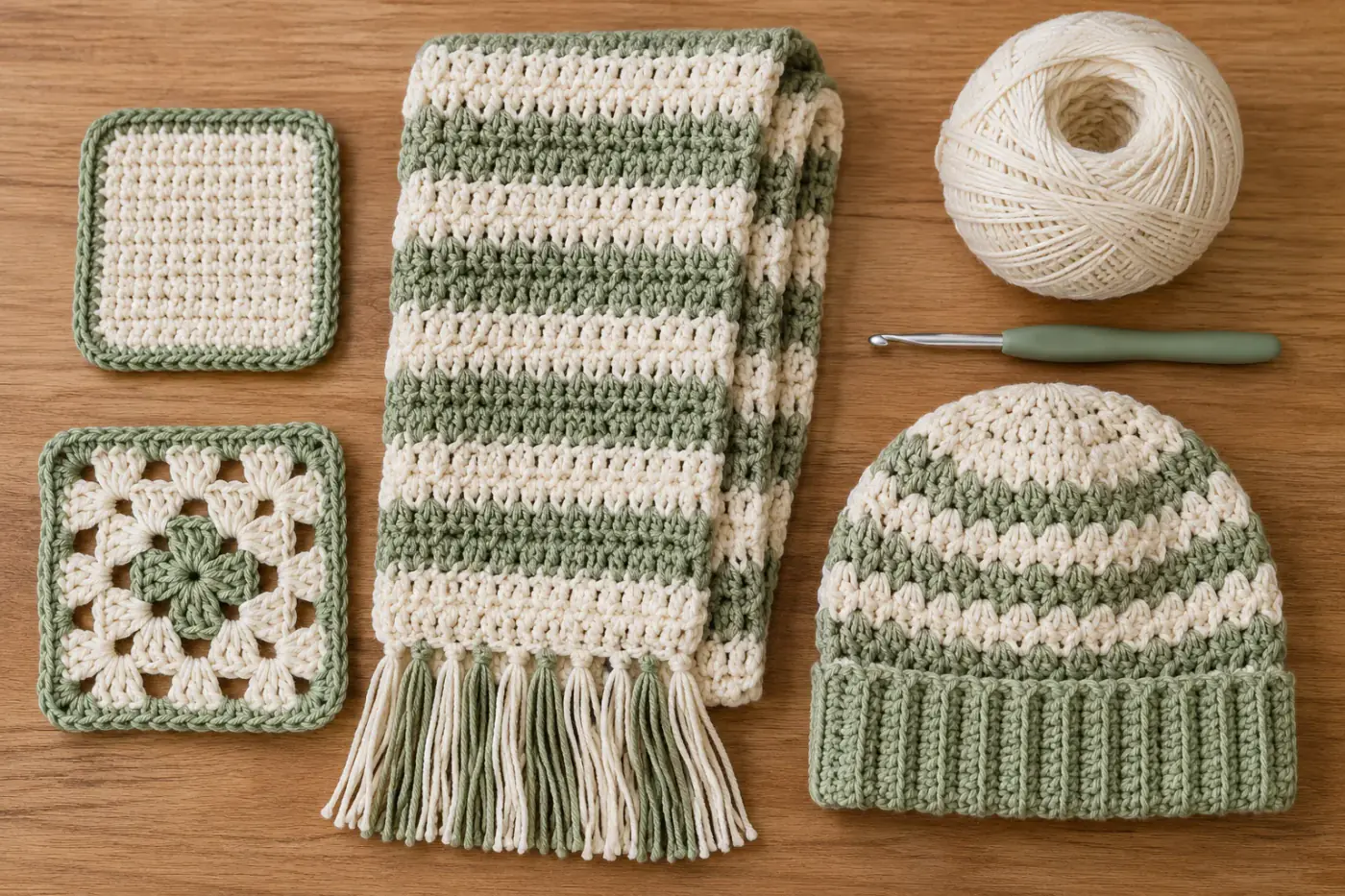
Four free crochet patterns with full written instructions on one page: a coaster, a scarf, a granny square and a beanie. No email wall, no download gate.

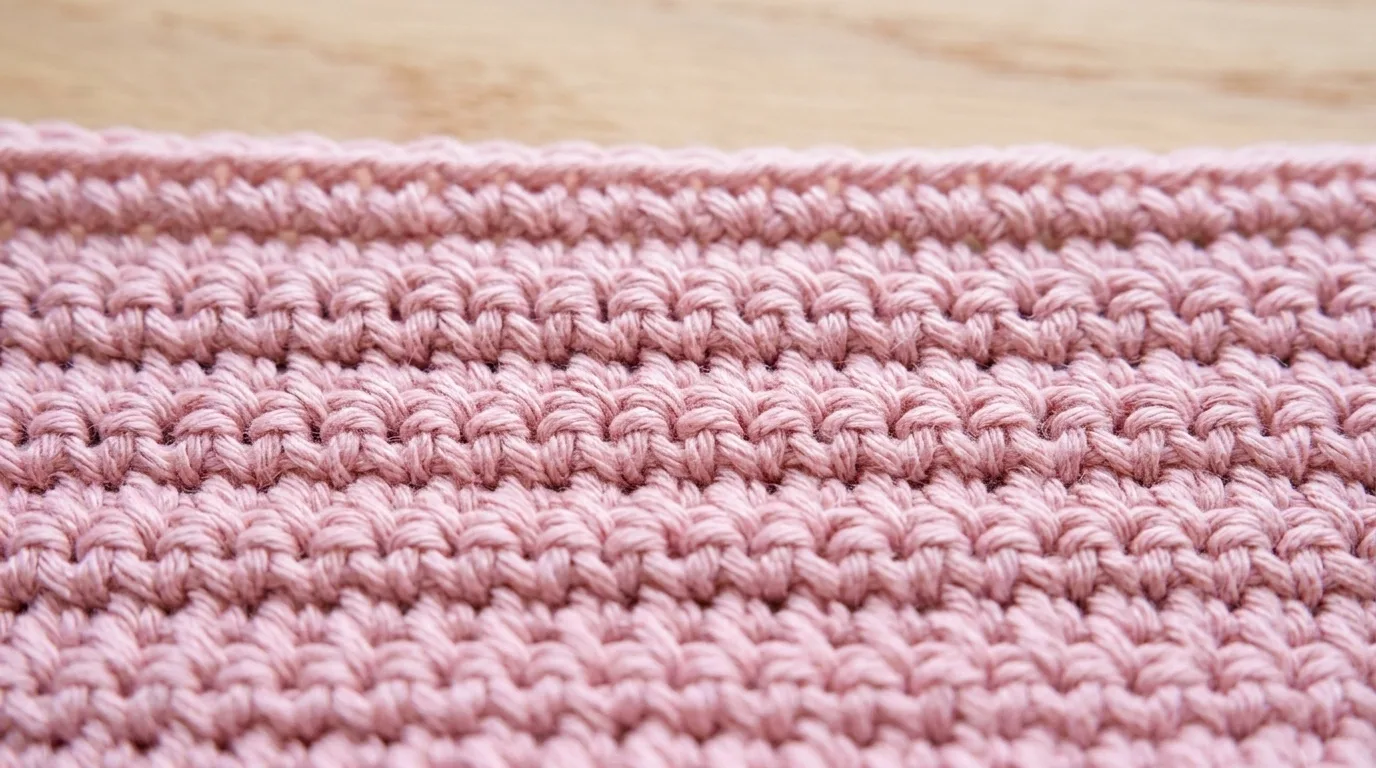
A clear walkthrough of crochet abbreviations and how to read a written pattern row by row.
Free crochet patterns are easy to find and hard to use: half are “free” only after an email signup, and many link to a video instead of written rows. This page collects four of our own patterns, each written out in full with materials, row counts and a stitch chart where it helps. In addition, you can crochet all four from the screen in front of you.
Terms used here: US terms throughout. The UK name appears the first time a stitch is used: single crochet (UK double crochet). Always check which system a pattern uses before you start, because the same word means a different stitch in each system.
Key takeaways
- Four complete free crochet patterns on one page: a coaster, a scarf, a granny square and a beanie, each with materials, row counts and a stitch chart.
- Every row carries a stitch count in parentheses, so you can check your work as you go.
- US terms are used throughout; UK names appear the first time a stitch is used.
- No email wall and no download gate: crochet straight from the page.
What “free” means on this page
- Full written instructions on the page, with a stitch count at the end of every row or round.
- No email wall, no PDF download gate, no account.
- A materials list with yarn weight, hook size, yardage and finished size.
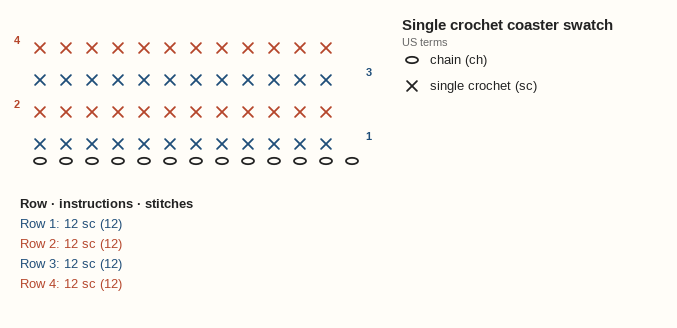
- A stitch chart for the flat and round pieces, drawn from the same rows as the text.
If a pattern here is new to you, start with the coaster. It uses one stitch and finishes in under an hour.
How to read a crochet pattern
A pattern row is shorthand. Once you know the code, it reads like a sentence.
Example row: Rnd 3: (sc, inc) x6. (18)
Rnd 3is round three.(sc, inc)is a group: one single crochet, then one increase (two single crochet in the same stitch).x6means repeat that group six times around.(18)is the stitch count you should have at the end.
Work the row, count your stitches, then move on. If the count is wrong, the next row will not fit, so fix it now.
Abbreviation key
| Abbreviation | US meaning | UK equivalent |
|---|---|---|
| ch | chain | chain |
| sc | single crochet | double crochet (dc) |
| dc | double crochet | treble (tr) |
| hdc | half double crochet | half treble (htr) |
| sl st | slip stitch | slip stitch |
| inc | increase (2 sc in one stitch) | increase |
| dec | decrease (sc2tog) | decrease |
| rnd | round | round |
| st(s) | stitch(es) | stitch(es) |
| yo | yarn over | yarn round hook (yrh) |
| sk | skip | miss |
| sp | space (a chain gap) | space |
| tog | together | together |
Gauge is the number of stitches and rows that fit in 4 inches (10 cm) of fabric; yarn weight is the thickness category (CYC 0 to 7) printed on the label. Skill level follows the Craft Yarn Council’s Basic, Easy, Intermediate and Advanced scale.
A few rules that trip up beginners:
- The number before a stitch is a repeat count:
6 scmeans six single crochet. - Parentheses group a repeat:
(sc, inc) x6. - Brackets often mark a section worked a set number of times.
- “Ch 3 (counts as first dc)” means the turning chain replaces a stitch; do not work an extra one.
Pattern 1: single crochet coaster
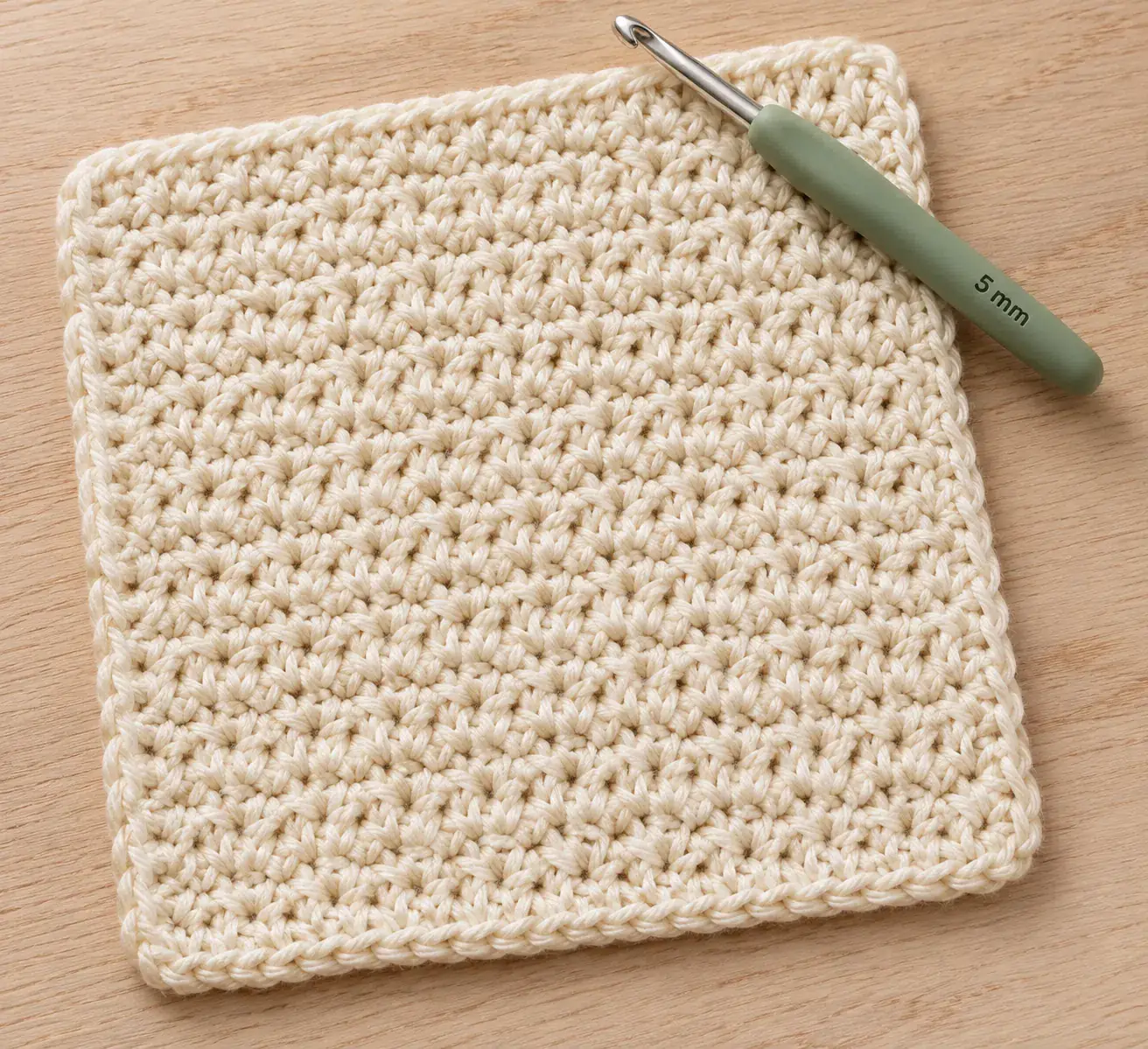
A flat square of single crochet. One stitch, straight edges, about 45 minutes.
Skill level: Beginner (Craft Yarn Council “Basic”). See skill levels.
Yarn: 4 / worsted, 100% cotton, about 30 yd. A single 120 yd ball makes four coasters with yarn to spare. See the Craft Yarn Council weight system.
Hook: 5 mm (US H-8).
Gauge: not critical for a coaster, because size does not affect function. About 16 sc and 18 rows per 4 in on this hook.
Finished size: about 4 x 4 in (10 x 10 cm).
Notions: scissors, yarn needle.
Rows:
- Foundation: ch 17.
- Row 1: sc in the 2nd ch from the hook and in each ch across. (16) Ch 1, turn.
- Rows 2 to 16: sc in each st across. (16) Ch 1, turn.
- Finish: fasten off and weave in both ends.
The maths: 17 chains minus the one next to the hook leaves 16 to work into, and each row replaces 16 stitches with 16. Therefore, sixteen rows at roughly one row per 0.25 in gives a 4 in square.
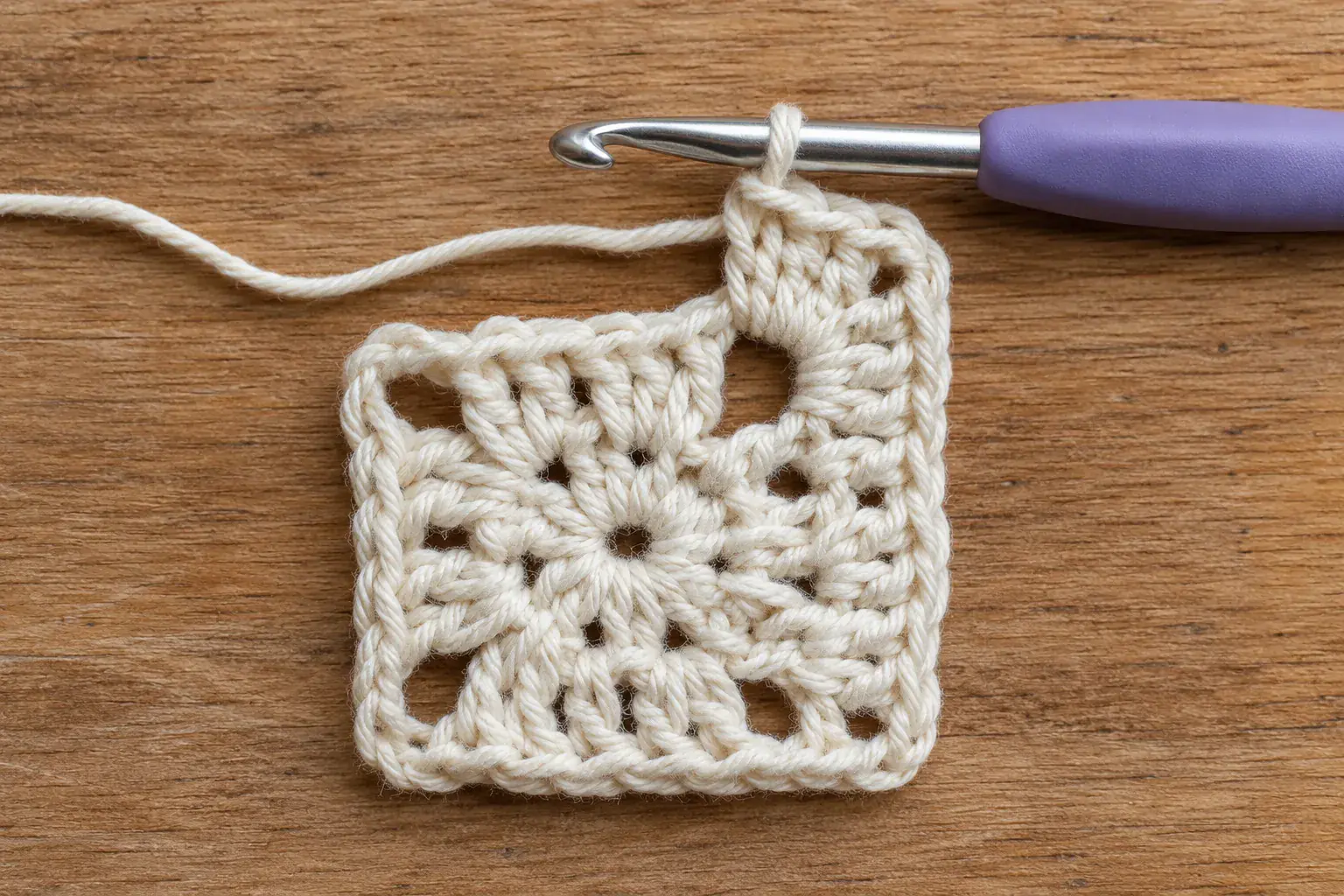
Top-down view of the coaster about halfway, with the hook waiting in the last loop.
Before you commit to all 16 rows, do a quick check: after row 5, count 16 stitches and confirm the sides run straight. For example, if the count drifts, pull back to the mistake and redo; only one loop is live in crochet, so mistakes rewind easily.
Troubleshooting: if the coaster cups (edges curl up), your tension is tight; go up one hook size for the chain only. If it ripples, you added a stitch at an edge; mark the first and last stitch of every row.
Pattern 2: double crochet scarf
Long rows of double crochet. Good for practising even tension over a big piece.
Skill level: Easy.
Yarn: 4 / worsted, acrylic or wool blend, about 400 yd (two 200 yd skeins).
Hook: 5 mm (US H-8).
Gauge: about 4 dc and 2 rows per inch. Not critical; the width and length are easy to adjust.
Finished size: about 5 in wide by 60 in long (13 x 150 cm).
Notions: scissors, yarn needle.
Rows:
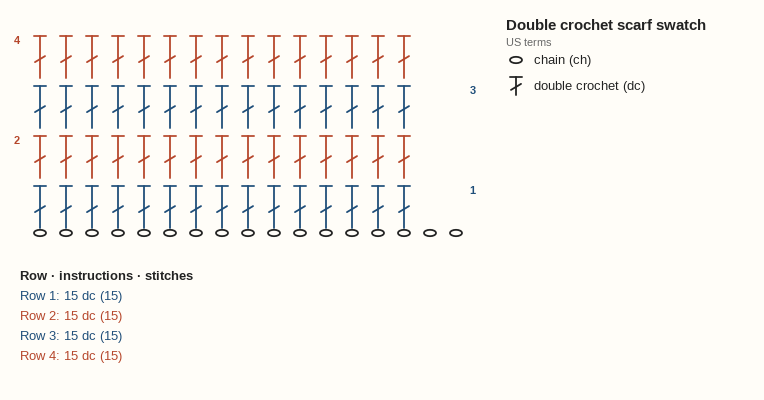
- Foundation: ch 23.
- Row 1: dc in the 4th ch from the hook and in each ch across. (20) Ch 3 (counts as first dc), turn.
- Row 2: dc in the next st and in each st across. (20) Ch 3, turn.
- Rows 3 to end: repeat Row 2 until the scarf measures about 60 in.
- Finish: fasten off and weave in both ends.
The maths: 23 chains minus the 3-chain turning allowance leaves 20 to work into, and each row keeps 20 stitches. As a result, at roughly 0.5 in per row, 120 rows gives 60 in.
Substitution note: a bulky yarn (category 5) with a 6.5 mm hook gives the same width in fewer rows and about 250 yd of yarn. For instance, cotton drapes less and weighs more; acrylic is lighter and easier to wash.
Pattern 3: classic granny square
The most useful motif in crochet. Make one for a coaster, or make forty and join them into a blanket.
Skill level: Easy, once you can chain and double crochet.
Yarn: 4 / worsted, acrylic or cotton, about 30 yd per 6 in square. Scraps work well.
Hook: 5 mm (US H-8).
Gauge: not critical; squares are joined to fit. Match tension across squares so they line up.
Finished size: about 6 in (15 cm) square after 4 rounds. Add rounds for a larger square.
Notions: scissors, yarn needle, a second colour for the centre if you like.
Rounds:
- Rnd 1: make a magic ring. Ch 3 (counts as dc), 2 dc in the ring, ch 2, (3 dc, ch 2) three times. Join with sl st to the top of the ch 3. (12 dc, 4 ch-2 spaces)
- Rnd 2: sl st to the next ch-2 space. Ch 3, 2 dc, ch 2, 3 dc in the same space (corner), ch 1. In each of the other three ch-2 spaces: 3 dc, ch 2, 3 dc, ch 1. Join. (24 dc)
- Rnd 3: in each ch-1 space work 3 dc, ch 1; in each ch-2 corner space work 3 dc, ch 2, 3 dc, ch 1. Join. (36 dc)
- Rnd 4: repeat, adding one 3-dc group to each side. (48 dc)
- Finish: fasten off and weave in. Block flat.
The maths: each round adds 12 dc, one group of 3 per side, so the count grows 12, 24, 36, 48. However, you can stop at any round for the size you want.
Granny squares are built from clusters in chain spaces, so a stitch chart is not shown here; the written rounds above are the source of truth.
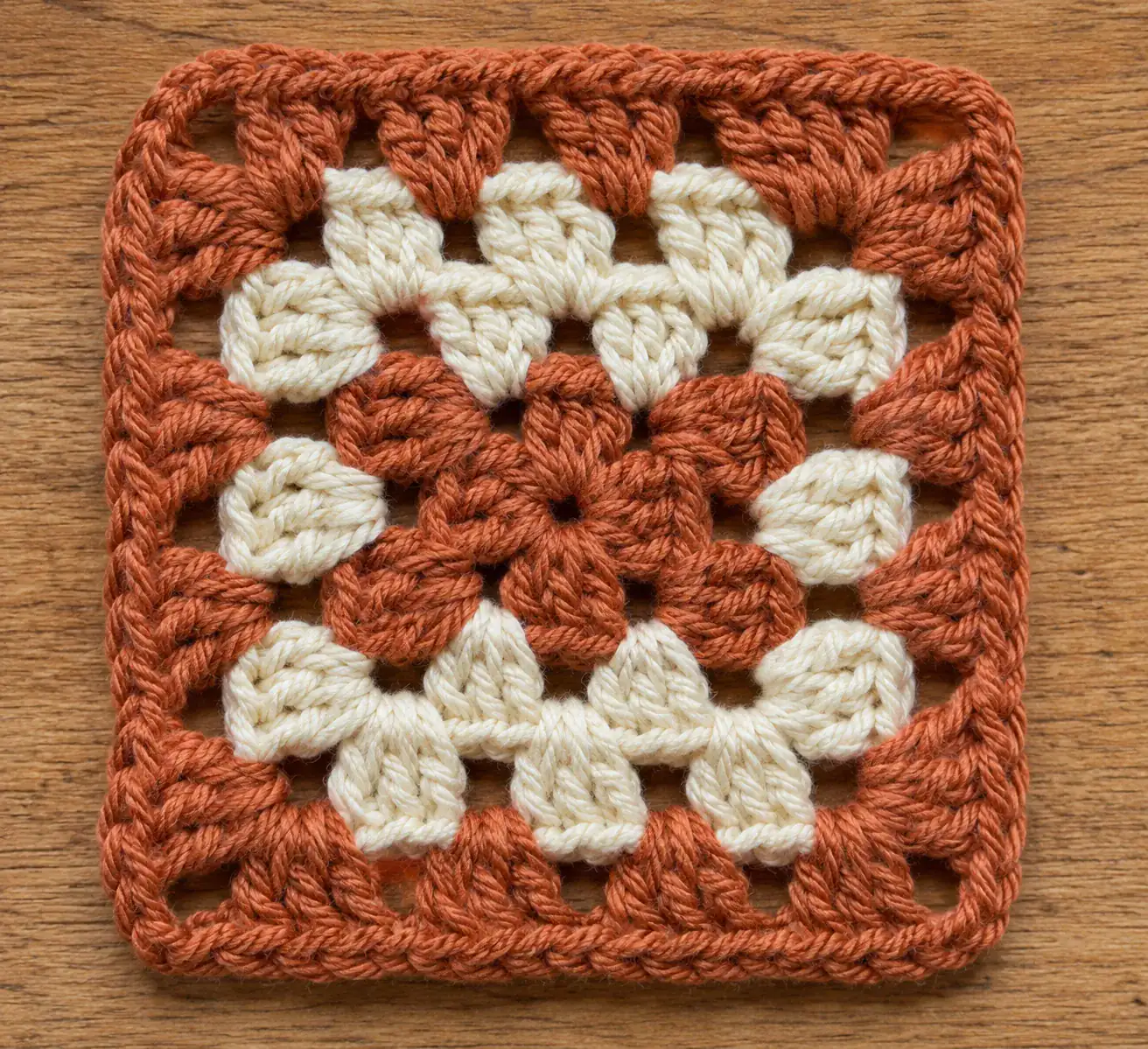
Three rounds of a classic granny square in two colours.
Troubleshooting: if the square ruffles, you added a group on a side; if it pulls into a bowl, you missed a group. Count the 3-dc groups each round: 4 in round 1, 8 in round 2, 12 in round 3.
Pattern 4: single crochet beanie
Worked top-down in the round. The crown increases, then the sides go straight.
Skill level: Easy.
Yarn: 4 / worsted, wool or acrylic blend, about 200 yd.
Hook: 5 mm (US H-8); 4.5 mm for the brim if you want it firmer.
Gauge: 16 sc per 4 in. Gauge matters for fit, so swatch first.
Finished size: adult, about 20 in (51 cm) circumference, 8 in (20 cm) tall.
Notions: scissors, yarn needle, stitch marker.
Crown:
- Rnd 1: 6 sc in a magic ring. (6)
- Rnd 2: inc in every st. (12)
- Rnd 3: (sc, inc) x6. (18)
- Rnd 4: (sc 2, inc) x6. (24)
- Rnd 5: (sc 3, inc) x6. (30)
- Rnd 6: (sc 4, inc) x6. (36)
- Rnd 7: (sc 5, inc) x6. (42)
Body:
- Rnds 8 to 20: sc in each st. (42) Place a marker in the first stitch of each round.
- Rnds 21 to 23: switch to the 4.5 mm hook if using; sc in each st. (42)
- Finish: sl st to the next st, fasten off, weave in.
The maths: the crown grows by 6 stitches every round (6, 12, 18, 24, 30, 36, 42), then holds 42 stitches for the body. Consequently, at 4 sc per inch, 42 stitches is about 10.5 in around, which stretches to fit a 20 in head.
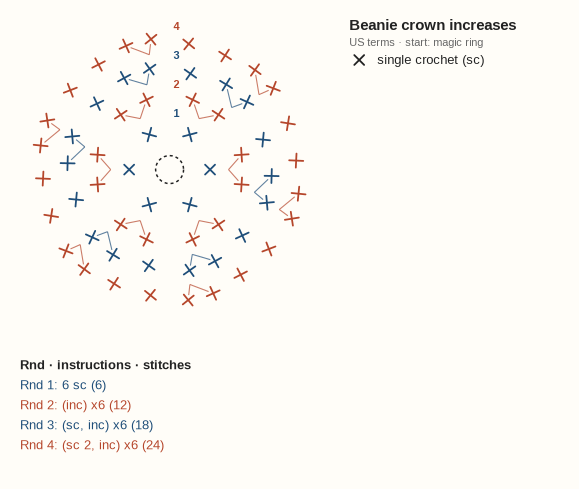
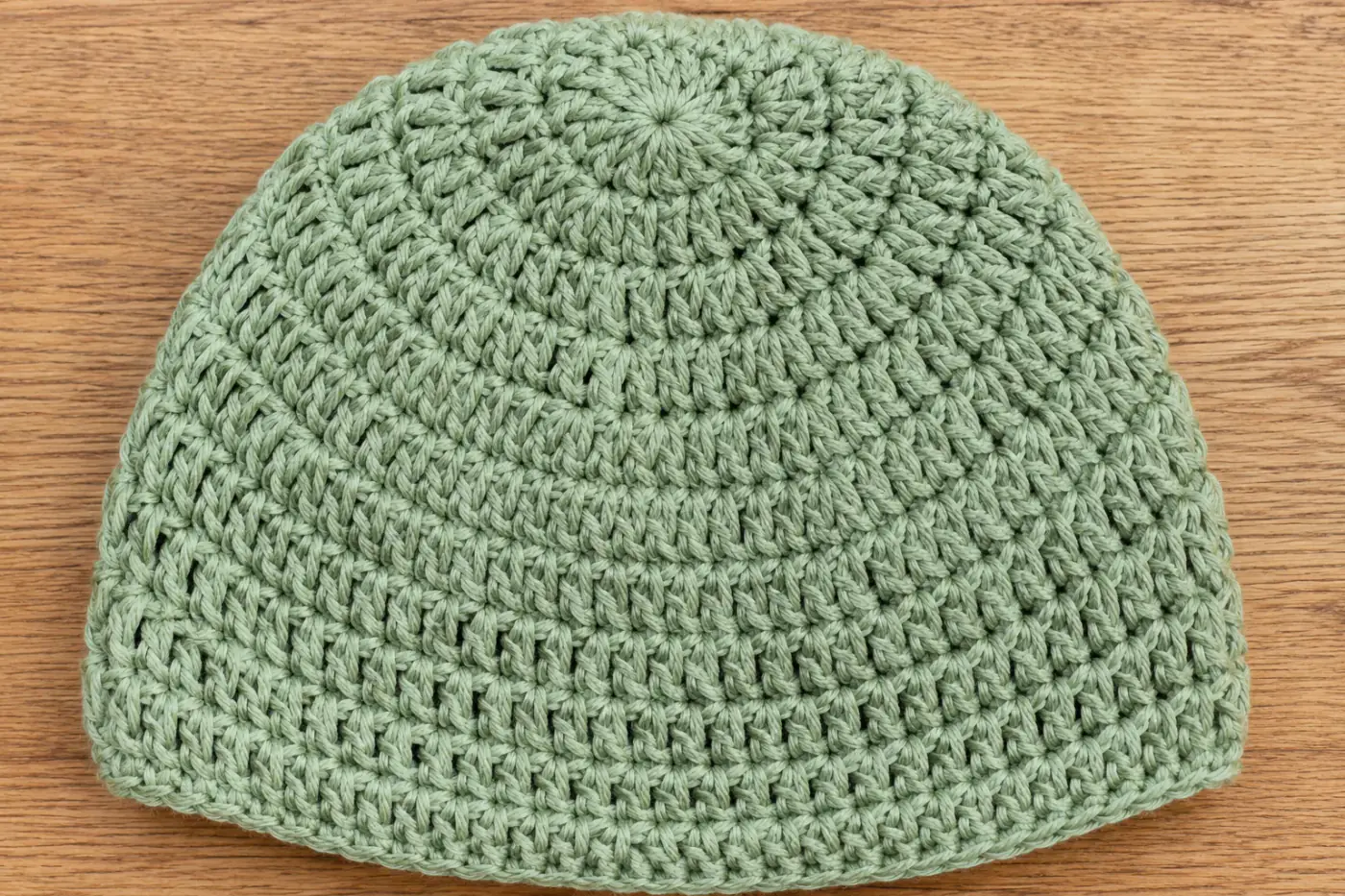
The beanie crown after the increase rounds, with the marker in the first stitch.
Troubleshooting: if the crown cups and will not lie flat, you missed an increase; if it ruffles, you added one. Check the count at the end of rounds 3, 5 and 7.
Common problems across all four patterns
However, most problems come down to count or tension, so check those first. Therefore, keep a stitch marker in the first and last stitch of every row.
| Problem | Likely cause | Fix |
|---|---|---|
| Stitch count drifts | Skipping or doubling a stitch at the edge | Mark the first and last stitch; count every row |
| Edges wave or ruffle | Too many stitches or tension too loose | Check the count; go down a hook size |
| Piece cups or bowls | Too few stitches or tension too tight | Check the count; go up a hook size |
| Yarn splits or frays | Hook too sharp or yarn too soft | Slow down; try a hook with a smoother throat |
| Hand aches | Gripping too hard | Take breaks; try an ergonomic handle |
For stitch-by-stitch help on your first project, see our how to crochet for beginners guide, which includes a complete first dishcloth pattern. If you are choosing a project by difficulty, our easy crochet projects for beginners list is sorted from simplest to slightly harder. Not sure which hook or yarn a project needs? Our guide to crochet hook sizes and yarn weights explains how to match them. For things to make for your home, see crochet home decor ideas, and browse everything in the crochet category.
All four patterns are free to use and share. If you make one, we would love to see it.
Frequently asked questions
Are these crochet patterns really free, with no email signup?
Yes. Every pattern on this page is written out in full, with materials, row counts and a stitch chart where it helps. There is no email wall, no PDF download gate and no account required. You can crochet straight from the page.
Can I sell items I make from these patterns?
You can sell finished items you make by hand. Please do not copy or resell the written pattern text itself. If you post a finished piece online, a credit to Hook & Fern is appreciated but not required.
What yarn can I substitute if I do not have the one listed?
Match the yarn weight number (the CYC category, such as 4 / worsted) and check your gauge. Fibre changes the drape and care: cotton holds shape and is washable, acrylic is soft and cheap, wool is warm but can felt. See the substitution notes under each pattern.
Why do some rows say (16) at the end?
That number is the stitch count you should have at the end of the row or round. Count your stitches before you turn or join. If the count is off, the next row will not fit, so fix it now rather than later.
How do I know which hook size to use?
Start with the hook printed on your yarn label. The Craft Yarn Council lists a range for each weight category, but the label is specific to that yarn. If your fabric is too stiff, go up one size; if it is floppy, go down one size.
Do I need to make a gauge swatch for these patterns?
For the coaster, granny square and beanie, gauge affects size, so a quick swatch is worth it. For the scarf, gauge only changes the width and length, which you can adjust as you go. The notes under each pattern say when gauge matters.
Sources
- Craft Yarn Council: Yarn Weight System— craftyarncouncil.com
- Craft Yarn Council: Crochet Abbreviations— craftyarncouncil.com
- Craft Yarn Council: Skill Levels— craftyarncouncil.com
- Yarnspirations: Lily Sugar'n Cream— yarnspirations.com
- Herrschners: Lily Sugar'n Cream gauge listing— herrschners.com
Photo credits
Thank you to AI illustration for sharing this photograph.